

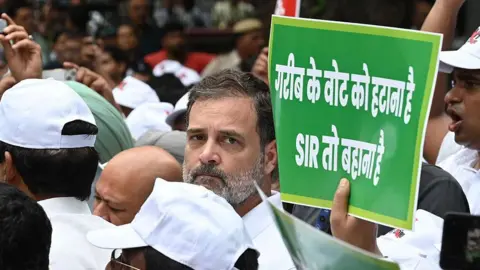
Indian politics has long been a theater of sharp debates, powerful accusations, and a constant struggle over the credibility of institutions that safeguard democracy. Among these institutions, the Election Commission of India (ECI) holds a particularly sacred role, as it is tasked with ensuring free and fair elections in the world’s largest democracy. Recently, Rahul Gandhi, one of India’s most prominent opposition leaders and a member of the Indian National Congress, reignited this debate by accusing the country’s poll panel of shielding what he called “vote thieves.” His statement has not only fueled a political storm but has also sparked questions about the integrity of electoral processes, the accountability of the ECI, and the broader health of democracy in India. By diving deep into the accusations, the responses, and the historical backdrop, this article aims to give readers a comprehensive understanding of why these remarks matter and what they reveal about the current political climate.
The Controversy at the Core
Rahul Gandhi’s comments came during a period of heightened political tension, with upcoming elections intensifying the battle between the ruling Bharatiya Janata Party (BJP) and the opposition coalition, known as the Indian National Developmental Inclusive Alliance (INDIA). Gandhi’s charge that the Election Commission is shielding “vote thieves” was not made in isolation—it taps into a larger narrative that the opposition has been building for years, alleging systemic bias and institutional capture under Prime Minister Narendra Modi’s government. The Congress leader framed the Election Commission as an institution that should have acted as a neutral referee but instead has allegedly tilted the field in favor of the ruling party.
Historical Concerns over Electoral Integrity
India’s electoral process has often been hailed as a remarkable democratic exercise, with nearly a billion eligible voters participating across diverse geographies, languages, and communities. However, the shadow of alleged electoral manipulation is not new. Accusations of booth capturing, voter intimidation, and misuse of state machinery date back decades. What makes Rahul Gandhi’s charge significant is that it targets the very credibility of the poll panel, suggesting not just isolated incidents of malpractice but an institutional failure. Critics argue that when a watchdog body is accused of complicity or partiality, it undermines the foundation of public trust upon which democracy rests.
The Opposition’s Broader Narrative
Rahul Gandhi’s statement aligns with the INDIA bloc’s larger messaging that democratic institutions in India are under stress. From the judiciary to investigative agencies, opposition leaders have consistently claimed that checks and balances are eroding. By labeling the Election Commission as a protector of “vote thieves,” Gandhi is appealing to public frustration with what many see as an uneven playing field. The strategy is clear: to cast doubt on the legitimacy of the electoral process itself, thereby galvanizing voters who may feel alienated or disenfranchised. Such a narrative is not just about this election cycle—it is about planting seeds of skepticism that could shape the political discourse for years to come.
Responses from the Ruling Party
The BJP and its allies have dismissed Gandhi’s remarks as baseless and irresponsible. Party spokespersons argue that the Election Commission has successfully conducted elections across challenging terrains and hostile conditions, earning international praise for its efficiency. They see Gandhi’s remarks as an attempt to preemptively undermine election results in case the opposition underperforms. Moreover, they argue that constant attacks on institutions weaken India’s democracy rather than strengthen it, framing the opposition’s strategy as one of disruption rather than constructive engagement.
The Election Commission’s Role and Defense
The Election Commission of India has not remained silent in the face of these criticisms. Officials have repeatedly emphasized that the institution functions independently, insulated from political influence, and committed to conducting free and fair polls. The ECI points to its track record of managing elections in a country of India’s scale as proof of its impartiality. Yet, even as it defends itself, questions linger. For many voters, particularly in opposition strongholds, perception often matters as much as reality. If people believe the referee is biased, the legitimacy of the match itself comes under question.
Public Sentiment and Grassroots Reactions
At the grassroots level, the impact of Rahul Gandhi’s accusations has been mixed. In urban areas where digital media dominates, the conversation often veers toward concerns about electronic voting machines (EVMs), voter lists, and allegations of manipulation. In rural areas, however, the narrative is more visceral—terms like “vote thieves” resonate strongly, tapping into long-standing distrust of elites and powerful institutions. Gandhi’s rhetoric, therefore, serves as a tool not just to question the Election Commission but also to mobilize anger and suspicion among voters who already feel excluded from the democratic process.
The Role of Electronic Voting Machines
One of the most persistent debates in Indian elections revolves around the use of EVMs. Critics argue that these machines can be tampered with, while the Election Commission insists they are secure and have undergone rigorous testing. Rahul Gandhi’s accusations indirectly feed into this debate, as many of his supporters connect the idea of “vote thieves” with suspicions about EVM manipulation. Independent experts, however, remain divided. While some argue that large-scale tampering is technically improbable, others stress that even the perception of vulnerability is damaging in a democracy of India’s size.
Global Comparisons and Lessons
India is not alone in grappling with accusations of electoral manipulation. From the United States to Brazil, accusations of vote tampering and institutional bias have shaken public confidence in elections. In the U.S., former President Donald Trump’s repeated claims of a “stolen election” in 2020 sowed widespread mistrust, even without concrete evidence. In Brazil, Jair Bolsonaro questioned electronic voting ahead of elections, leading to political unrest. By making his accusations, Rahul Gandhi is effectively placing India within this global pattern, where losing parties increasingly challenge the legitimacy of democratic institutions rather than accept electoral defeat.
The Stakes for Indian Democracy
At stake here is not just the credibility of one election but the future of India’s democratic culture. When opposition leaders accuse the poll panel of protecting “vote thieves,” they are raising doubts about whether the electoral system itself is trustworthy. If such doubts persist, voter turnout could be affected, with disillusioned citizens opting out of the process altogether. This creates a vicious cycle: fewer voters, less legitimacy, and deeper mistrust. The long-term consequences could be devastating for the democratic fabric of the nation.
Expert Opinions on the Controversy
Political analysts and constitutional experts have weighed in on Gandhi’s remarks. Some argue that his statement reflects genuine concerns about institutional bias and should not be dismissed outright. Others believe it is a calculated political move aimed at energizing the opposition base. According to one political scientist, “In a democracy as large and complex as India’s, the perception of fairness is as critical as the actual conduct of elections. When leading opposition figures suggest that fairness has been compromised, it inevitably erodes trust—even if the accusations are not substantiated with concrete evidence.”
The Media’s Role in Amplifying the Debate
Media coverage has played a critical role in magnifying the controversy. Opposition-leaning outlets have highlighted Gandhi’s remarks as a bold critique of institutional capture, while pro-government channels have framed them as reckless attacks on democracy. Social media has further polarized the debate, with hashtags and viral videos shaping public perception. In an era where digital narratives spread faster than fact-checks, the impact of Gandhi’s statement may be less about its factual accuracy and more about its resonance with people’s emotions.
The Way Forward
The challenge now lies in restoring trust. For the Election Commission, this means adopting greater transparency in its processes, engaging with independent auditors, and communicating more openly with the public. For political parties, it means balancing criticism of institutions with constructive proposals for reform. Civil society organizations, too, have a role to play in monitoring elections and ensuring accountability. Ultimately, the health of India’s democracy depends on a collective effort to uphold both the perception and the reality of electoral fairness.
FAQs
What exactly did Rahul Gandhi say about the Election Commission?
Rahul Gandhi accused the Election Commission of shielding “vote thieves,” suggesting that the poll panel is biased in favor of the ruling BJP and failing to ensure fair elections.
Why are these accusations significant?
The accusations matter because they target the credibility of an institution central to India’s democracy. If the Election Commission is seen as partial, public trust in elections could be seriously undermined.
Has the Election Commission responded to these claims?
Yes, the Election Commission has consistently defended its independence and impartiality, citing its record of successfully conducting elections in challenging conditions across India.
Are electronic voting machines at the center of this controversy?
While Rahul Gandhi did not specifically mention EVMs in this instance, his remarks feed into a broader debate about the security and reliability of EVMs, which many critics link to concerns about electoral manipulation.
How does this controversy compare to global electoral disputes?
Similar disputes have occurred in countries like the United States and Brazil, where accusations of stolen elections or biased institutions have eroded public trust, even without solid evidence.
What impact could these accusations have on Indian democracy?
If public trust in the electoral process erodes further, it could lead to lower voter turnout, increased polarization, and long-term damage to India’s democratic culture.
Conclusion
Rahul Gandhi’s charge that the Election Commission is shielding “vote thieves” has stirred up a storm in Indian politics, bringing to the forefront questions about the integrity of elections and the neutrality of democratic institutions. While his critics dismiss the remarks as political theater, the very fact that such allegations resonate with large sections of the public is cause for concern. The health of India’s democracy depends not just on the mechanical conduct of elections but also on the perception that they are free, fair, and beyond manipulation. As India prepares for its next electoral battles, both the opposition and the ruling party must recognize that democracy’s greatest strength lies in the trust of its citizens. Without that trust, even the largest democratic exercise risks being reduced to a hollow ritual.